
Piano Removal
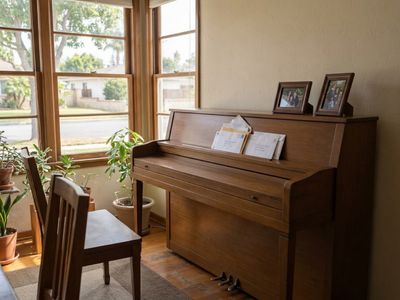
Upright and spinet pianos carried out of houses, apartments and estate homes and hauled away. The cabinet doesn't come apart. So we walk the stairs, the turns and the doorway first, then move it out braced as one piece. If it's still in tune and playable, we try to place it before it goes to disposal. Serving Downey, Bellflower, Norwalk, Long Beach and nearby cities, 7 days a week. Call or text with the kind of piano and how many steps stand between it and the door.
Usually the lessons stopped years ago
Almost nobody calls the week a piano goes quiet. It sits through a few years of a closed lid and a stack of mail on top before anyone searches for a way to move it. Some are inherited, a parent's piano nobody in the new house plays. Others are the upright bought for lessons that stopped in middle school.
By the time someone calls, they've usually tried the easy paths first. Listed it free online, called a charity, asked at church. A piano used to move that way fast. Most don't anymore.
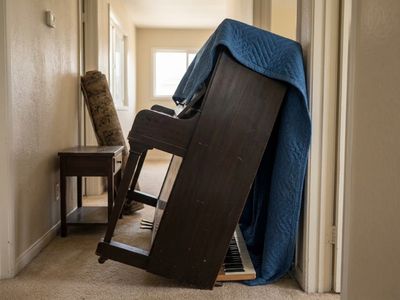
It isn't a piece of furniture that comes apart for a tight spot. It's one dense, rigid object that has to travel as a whole through every stair and doorway between it and the trailer.
What we take
- Upright, console and studio pianos
- Spinet pianos
- The bench
- A staircase, landing or tight turn on the way out
- A standard doorway, angled on its side
- Loaded and hauled off once it's out the door
How a piano leaves the house
- Tell us upright, console or spinet, and how many steps or turns stand between it and the door.
- We walk the route first. The whole cabinet moves as one piece, so there's no lightening it partway through.
- It gets braced and tipped onto its side where the doorway calls for it, and carried out without setting it down mid-turn.
- If it's still in tune and playable, we try to place it with someone who'll use it before it goes to disposal.
- It's loaded and hauled away, and the bench goes with it.
Two things that help
- Clear a path from the piano to the door.
- Tell us which kind it is, spinet through full upright.
- Clear anything sitting on top of it.
What kind of piano you have
- Spinet. The smallest upright, around 38 inches tall and 200 to 300 pounds. The easiest of the group to angle through a doorway.
- Console and studio upright. Taller and heavier, commonly 500 to 600 pounds. The size most people picture when they say piano.
- Full upright. The tallest of the family, sometimes close to five feet and up toward 800 to 1,000 pounds. Same one-piece cabinet, just more of it.
The measurement that matters
A piano is deep, not wide
Look at a full upright's long face and a standard 30- to 32-inch doorway looks impossible. That face commonly runs close to five feet. But depth is what decides it, not width, and most upright cabinets are only 24 to 26 inches deep. Turned onto its side, most clear a door the long face never would.
The stairs can't be undone partway through. A piano doesn't flex or come apart to shed weight, so a landing with a turn has to be planned before anyone lifts, not worked out halfway down.
Tell us if there's a turn on the landing or a narrow apartment stairwell when you book. That one detail decides how the piece comes out more than anything else about the job.
What happens to it
A piano that still plays gets offered on first
If it's in tune and playable, we try to place it with someone who'll use it before it goes to disposal. That's the practice, not a guarantee, since fewer people want an old piano than a generation ago.
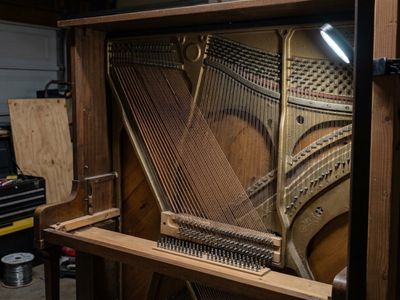
Most of what we're called for hasn't played in years. A cast iron plate, a hardwood cabinet and roughly two hundred steel strings under tension don't come apart into one clean material, and we won't pretend a piano's disposal is tidier than it is.
When what's left over is clean enough to reuse or recycle, it stays out of the landfill.
Who shows up
Crew and equipment
Every job runs out of an 8 × 12 ft dump trailer with 4 ft sides, about 14 cubic yards of space. Most jobs get a two-person crew, and we do all the lifting, loading and sweeping up.
What people try before they call
- Listing it free. The used piano market has thinned out. A free upright, especially an older console, can sit online for months because nobody wants to arrange moving a few hundred pounds themselves.
- A piano-specific charity. Some still take instruments in playable shape, but many now ask for photos, a serial number and days to respond, and plenty of pianos don't survive the wait.
- City bulky pickup. Built for furniture a resident can carry to the curb alone. Getting a several-hundred-pound cabinet from the room to the street is the actual job, and that part isn't included.
- Trying to dismantle it yourself. Roughly two hundred strings under real tension and a cast iron plate that size make this an injury risk, not just a weekend project. Most vehicles couldn't carry the pieces afterward anyway.
Still deciding what to do with it?
Piano Removal questions
Why won't anyone take my piano for free?
The used piano market has cooled off. Supply of older uprights outpaces demand, so free listings can sit for weeks even on a piano that still plays.
Can a piano go down a narrow staircase?
Usually, if there's a plan for the turn. We walk the stairwell first and decide how it rotates before anyone lifts, since the cabinet can't be lightened partway down.
How do I know if I have a spinet or a full upright?
Height is the fastest way. A spinet is around 38 inches tall. A console or studio runs taller, and a full upright is the tallest of the group, sometimes close to five feet.
Can you take the piano apart to get it out of a tight spot?
No. The cabinet, the plate and the strings don't separate the way furniture does. Every piano leaves as one piece, angled and carried, never disassembled.
Locations served
Find us in your community
- Downey
- Whittier
- Paramount
- Long Beach
- Norwalk
- Bellflower
- Santa Fe Springs
- Anaheim
- Compton
- Lynwood
- Glendale
- Lakewood
- Pasadena
- Torrance
- Fullerton
- Los Angeles
- Pico Rivera
- Garden Grove
- South Gate
- Bell Gardens