
Office Furniture Removal
Desks, cubicles, filing cabinets, conference tables and office seating cleared from a single office or a full floor. Long cubicle runs come apart into panels so they clear a standard doorway, and a loaded filing cabinet gets emptied before it's carried. Matched sets in good shape get donated as a full run; the rest gets hauled. Serving Downey, Bell Gardens, South Gate and nearby cities, 7 days a week. Call or text and tell us how many desks are leaving.
The furniture is what's left standing after the move is planned
An office move gets planned around the new address. What's staying behind gets planned around almost nothing, until the lease end date forces it. A landlord wants an empty floor by a set day, and the desks, cubicles and filing cabinets are what's still standing on it.
That date usually sits weeks out, not tomorrow. A company downsizing, closing a location or shrinking its footprint for remote work knows its move-out day before the packing even starts.
It's also a different kind of job once it starts. A floor of desks and cubicle runs doesn't leave the way a truckload of boxes does. Most of it has to come apart first.
What clears off the floor
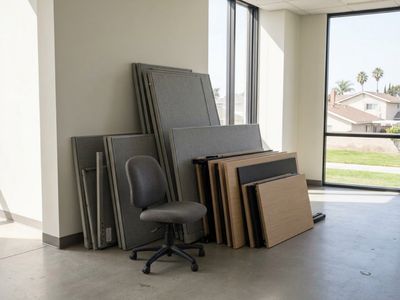
- Desks, credenzas and conference tables
- Cubicle panels, whole or broken into sections
- Filing cabinets, emptied or still loaded
- Office and task chairs, matched sets included
- Reception furniture, whiteboards and breakroom furniture
- A floor left swept, not just emptied
How a floor gets cleared
- Tell us the rooms, the floors and roughly how many desks and cubicles.
- Long cubicle runs get broken into panels first. Anything that already fits through the door goes out whole.
- Loaded filing cabinets get emptied, then carried.
- A conference table comes apart at the base before the top goes anywhere.
- The floor gets swept once the last piece is out.
Before the crew arrives
- Tell us if cubicle runs are still connected, so we plan time to break them down.
- Empty filing cabinets ahead of time if you can. It's faster than we can do it.
- Wipe or remove drives with company data before anything leaves.
- Point out any pieces the landlord needs to stay.
What's on the floor
- A single office or suite. A handful of desks and chairs. Usually one visit, no disassembly to plan around.
- Cubicle rows. Long or connected runs come apart into panels before anything moves. A desk that already fits through the door goes out whole.
- Filing cabinets. A loaded four-drawer cabinet can outweigh the desk beside it. Emptying it first is the fastest way through.
- Conference tables. The one piece here that doesn't disassemble like a cubicle. The base and legs separate from the top instead.
- A full floor. Same job, more rows. We work it run by run instead of all at once.
The floor plan decides the order
A wide doorway doesn't help a cubicle that's still one piece
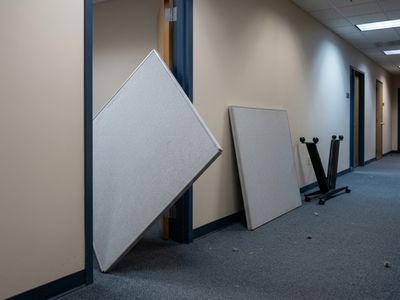
Most interior office doorways run wider than a house's, close to 36 inches on a lot of commercial buildings. The doorway isn't the problem on an office floor. A cubicle run built to stay connected is: panels click together at hidden connectors along the top and base, and pulling on the outside edge just flexes the row instead of separating it. Finding those clips is what takes the time.
A conference table is the opposite problem. The top is one slab that doesn't break down piece by piece. The base and legs come off, and the top travels through whatever door it fits.
What leaves in one piece
A matched run of desks has somewhere to go. One mismatched chair usually doesn't
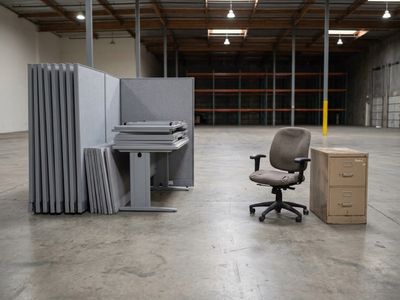
A matching run of cubicles or desks from one office is worth more donated as a set than the same pieces broken up and mixed with everything else on the floor. Kept together, it's furniture someone can furnish a room with.
That's why runs and sets stay together as long as it doesn't slow the job down. A clear match in good shape gets donated, instead of sitting in a donation queue nobody wants.
Whatever doesn't match or isn't in shape to be reused gets hauled the same as anything else. A mixed office load is no better sorted than a household one, and we won't claim otherwise.
Who shows up
Crew and equipment
Every job runs out of an 8 × 12 ft dump trailer with 4 ft sides, about 14 cubic yards of space. Most jobs get a two-person crew, and we do all the lifting, loading and sweeping up.
Other ways an office empties out
- An office decommissioning or liquidation firm. Built for a large, multi-floor job with resale value behind it. Needs contracts and lead time a smaller office usually doesn't have to spare.
- Donating directly to a school or nonprofit. Works when the furniture is a clean, matching set and somebody there has room for it. Finding a taker for mismatched pieces is usually on you.
- Asking the movers to take the leftovers too. Movers are booked around what's going to the new address. What's left behind is an add-on request that tends to slip.
- Employees clearing it on their own time. Fine for a handful of light items. Cubicle disassembly means finding hidden connectors most people have never looked for.
Got a floor full of desks?
Office Furniture Removal questions
Do you take cubicles apart, or do they come out whole?
Whatever fits through the door goes out whole. Long or connected runs get broken into panels first, since the connectors won't let a run separate any other way.
Can you clear a whole floor, or just a few desks?
Both. A few desks is a short visit. A full floor is the same process, run by run, across as many loads as it takes.
Can you send a certificate of insurance for our building?
Yes, on request. We carry general liability insurance, and a certificate is normal paperwork for getting a crew approved on site.
What happens to furniture that's still in good shape?
A matched set in good shape gets donated as a full run. A single mismatched piece usually doesn't find a taker, so it's hauled with the rest.
Do you handle the computers and monitors too?
Small office electronics leaving with the furniture get recycled. A large batch of desktops or a copier is its own job, and the computer and printer page covers that.
Does someone need to be on site the whole time?
No, as long as we know how we're getting in and which pieces are staying.
Locations served
Find us in your community
- Downey
- Whittier
- Paramount
- Long Beach
- Norwalk
- Bellflower
- Santa Fe Springs
- Anaheim
- Compton
- Lynwood
- Glendale
- Lakewood
- Pasadena
- Torrance
- Fullerton
- Los Angeles
- Pico Rivera
- Garden Grove
- South Gate
- Bell Gardens