
Appliance Removal
Stoves, ovens, dishwashers, water heaters and window AC units hauled away and recycled. Disconnect the gas and the hardwired units first and we do the lifting from there, down the stairs and out to the trailer. A whole kitchen's worth can go in one trip. We've hauled fridges and wine coolers out of homes around here. Serving Downey, Whittier, Norwalk, Santa Fe Springs and nearby cities, 7 days a week. Call or text and we'll come take it.
Usually it's the whole kitchen, not one machine
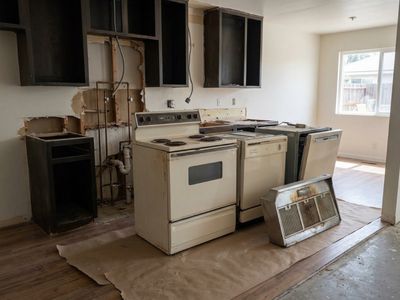
The single-appliance call happens, but the more common one is a remodel or a rental turnover where three or four units leave at once. A stove, a dishwasher, a range hood, sometimes a built-in microwave, all going out the same kitchen doorway in an afternoon.
They're all different shapes and none of them is friendly. A stove is heavy and square. A dishwasher is fastened into the cabinets on three sides. A water heater is a barrel that has to come out of a closet. Loading them together is a different problem from carrying one thing to the curb.
Plenty of these still work. An appliance gets replaced for capacity, for style, or because the rest of the kitchen got new ones and it no longer matches. That's a normal reason and you don't have to justify it to us.
Appliances we take
- Stoves, ranges and wall ovens
- Dishwashers and built-in microwaves
- Water heaters, gas and electric
- Window and wall air conditioning units
- Range hoods and cooktops
- Refrigerators, freezers, washers and dryers, which have their own pages
- Trash compactors and garbage disposals
How a swap-out goes
- Tell us which appliances and which room they're in.
- We check what's already disconnected before anything moves.
- Each one comes out on a dolly, down the stairs if that's the route.
- Multiple units get staged outside and loaded together, heaviest first.
- Appliances and electronics go to a recycler rather than the landfill.
Your side, before we arrive
- Have gas lines shut off and disconnected before we arrive. Gas stoves, gas water heaters and gas dryers all count.
- Hardwired units need to be disconnected too.
- Drain a water heater at the base valve. A full tank weighs several hundred pounds more than an empty one.
- Clear a path from the appliance to the door.
The ones without their own page
- Stove or range. Gas models need the line shut off and disconnected first. Electric ones are usually a plug behind the unit.
- Dishwasher. Not sitting loose in the gap. It's screwed to the underside of the counter with a water line, a drain line and power all attached, so it has to be fully detached before it slides out.
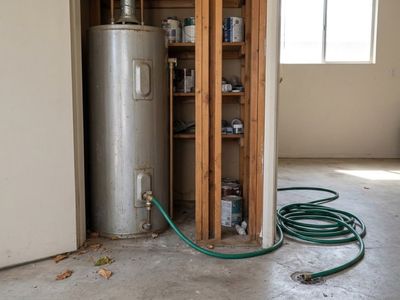
- Water heater. Around 100 to 150 pounds empty, and a 40-gallon tank holds another 335 pounds of water. Drain it at the base valve with a garden hose first. That's not busywork, it's the difference between a carry and an ordeal.
- Window or wall AC. Compact and deceptively dense. A mid-size unit runs 50 to 100 pounds packed into a box about two feet across, and it has to come back through the window opening.
- A whole package at once. Kitchen remodels and rental turnovers, three to five units in one visit. Say so when you book and we'll plan the staging.
The split that matters
Some of these hold refrigerant, most don't
Appliances fall into two groups and the difference decides how each one is handled once it leaves. Fridges, freezers and window AC units hold refrigerant in a sealed system. Stoves, ovens, dishwashers and water heaters don't.
The refrigerant side is regulated and has to be recovered by someone certified for it before the unit is scrapped. The fridge page goes into that properly. On this page it just means an AC unit and a dishwasher don't follow the same path out.
Everything on the non-refrigerant side is mostly a weight and geometry problem. Get it disconnected, get it on a dolly, get it through the doorway.
Afterwards
Appliances are the easiest thing on the trailer to do right
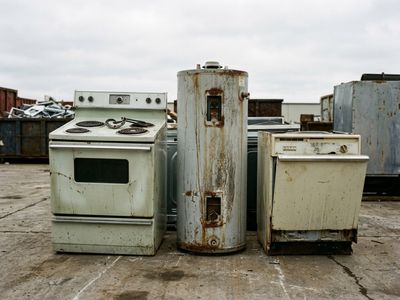
Old appliances go to a recycler. They're mostly steel, and a single-material load of metal is one of the few things with an obvious destination rather than a mixed one.
That's why we'll say it plainly here and hedge on a mixed household load. A stove is steel. A water heater is steel with some insulation. There's no guesswork in where those go.
Anything that still works and somebody could use gets passed on instead.
Who shows up
Crew and equipment
Every job runs out of an 8 × 12 ft dump trailer with 4 ft sides, about 14 cubic yards of space. Most jobs get a two-person crew, and we do all the lifting, loading and sweeping up.
The other ways an old appliance leaves
- Delivery haul-away. Hard to beat when it applies. The retailer takes the old one when they bring the new one, though usually only the unit being directly replaced, and usually only if you set it up when you ordered.
- City bulky pickup. Most cities take appliances, scheduled ahead with a cap on items. You get them to the curb yourself, which for a water heater or a stove is the entire difficulty.
- A scrapper. Some will collect metal appliances for free. Availability is unpredictable, timing is theirs, and they'll take the valuable ones and leave the rest.
- Your installer. Plumbers and appliance fitters sometimes remove the old unit as part of the job. Worth asking before you book anyone else, though it's often an extra visit.
- Leaving it in the garage. Where a surprising number of replaced appliances live for years. It works right up until you want the space.
New ones arriving soon?
Appliance Removal questions
Do you disconnect the gas?
No. Gas lines and hardwired units need to be disconnected before we arrive, by you or by whoever installed the new one. Once it's free, all the lifting is ours.
Can you take several appliances at once?
Yes, and that's the usual version of this job. A kitchen's worth in one visit is normal, just tell us how many when you book.
Do you take window air conditioners?
Yes. They're heavier than they look and they have to come back through the window, so tell us which floor it's on.
It still works. Will you take it anyway?
Yes. Most appliances we haul still run. Being replaced is reason enough and it makes no difference to us.
Do you take the water heater out of the closet?
Yes. Drain it first at the valve near the base, and have the gas or the wiring disconnected. Then it's just an awkward carry, which is our end.
What about the dishwasher? It won't budge.
It's screwed to the underside of the counter and connected on three sides. Once the water, drain and power are off and the screws are out, it slides straight out.
Locations served
Find us in your community
- Downey
- Whittier
- Paramount
- Long Beach
- Norwalk
- Bellflower
- Santa Fe Springs
- Anaheim
- Compton
- Lynwood
- Glendale
- Lakewood
- Pasadena
- Torrance
- Fullerton
- Los Angeles
- Pico Rivera
- Garden Grove
- South Gate
- Bell Gardens