Drywall, lumber, tile, cabinets, fixtures and the mixed pile a renovation leaves behind, one load or several as a job runs. Nothing has to be pre-sorted, and big pieces get broken down when it saves room in the trailer. A Van Nuys renovation we cleared in August is on this page with before and after photos. Serving Downey, Whittier, Pico Rivera and nearby cities, 7 days a week. Call or text once a phase wraps.
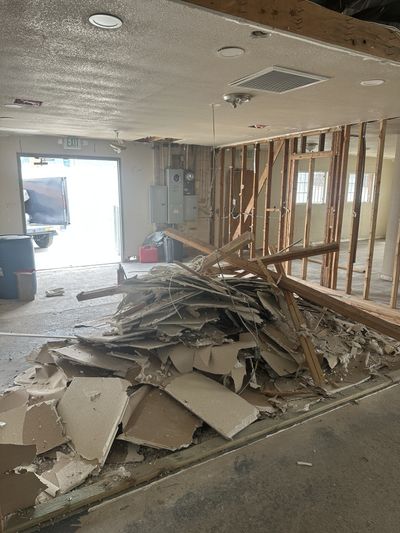
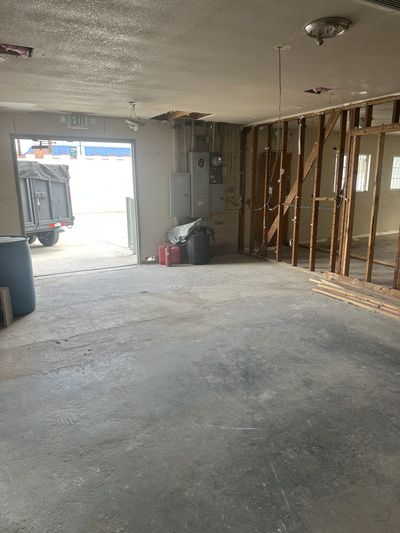
Broken drywall and lumber from a renovation, piled where the next trade needed to work. It went out mixed, the way it sat, with the trailer backed up to the door.
Van Nuys, Los Angeles · August 2026
The pile follows the framer's schedule, not a rental company's
A renovation doesn't make debris once. It makes it in bursts: demo material one week, framing offcuts the next, then drywall trim once that phase starts. Each pile looks nothing like the one before it, and a dumpster sized for the whole job sits mostly empty for most of that time.
A hauling trip works the other way. It shows up once a pile is in the way, whichever phase that happens to be, and it's gone before the next trade needs the space. A dumpster fills as a job runs. A hauling trip clears what's already there.
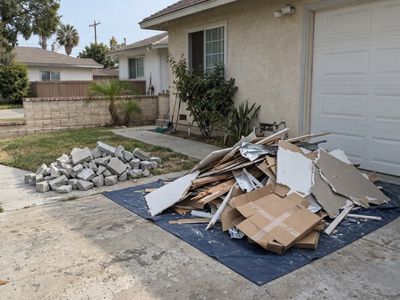
The pile doesn't need to be sorted first either. Drywall, lumber, tile, cabinet doors and packaging from the same phase go in the same load, the way they sit.
What comes off the job site
✓ Drywall, lumber and trim scraps
✓ Tile, cabinets, countertops and fixtures
✓ Flooring already pulled up
✓ Packaging and offcuts from a new install
✓ Mixed piles, loaded exactly as they sit
How a job-site pickup runs
Tell us roughly what phase it's coming from and how much of it there is.
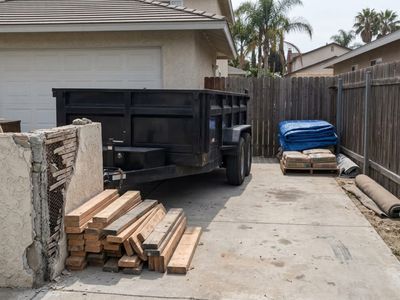
We back the trailer as close to the pile as the driveway, alley or curb allows.
Big pieces get broken down first. Breaking a cabinet or a long stud run down saves room in the trailer and makes the carry easier.
It loads mixed, the way it sits. Nothing needs sorting first.
We sweep the spot before we go, so the next trade has room to work.
Before the trailer shows up
✓ Tell us roughly what phase the debris is from, so we know what to expect.
✓ Pile it where the trailer can reach: driveway, alley or curb.
✓ Point out anything staying, especially material another trade still needs.
What phase it's coming from
✓Demo. The heaviest pile of the job, and often the one with concrete or tile mixed in. The concrete and dirt page covers the physics of a load that's heavy before it's full.
✓Framing. Lumber offcuts, blocking and packaging. Bulky and light, the opposite problem from demo.
✓Drywall and finishing. Board scraps, trim, old flooring and cabinet doors, usually the mix sitting in the driveway when the call comes in.
✓Punch list. The last small pile once a job is basically done. Same trailer, whatever's left.
Job sites aren't built for easy access
The trailer has to reach the pile before anything else happens
An active job site usually has more in the way than a driveway does: other trades' materials staged nearby, a dumpster from an earlier phase still sitting there, a narrow alley behind the building, or parking already spoken for by the crew working that day. Tell us what the site looks like when you book. A tight site is still workable, it just takes longer.
We clear a real path back out when we're done, not just to the pile and back. A site about to have another trade walking through it needs an open route more than a driveway does.
Why sorting the pile first wouldn't help much
A mixed load gets handled the way it arrives
We don't ask a renovation pile to be pre-sorted before we get there, because a mixed load doesn't get sorted material by material once it leaves either. Drywall, wood, tile and packaging from the same phase travel and get handled together.
That's different from a load that's one material and nothing else. A trailer that's only clean broken concrete has an obvious destination, and the concrete and dirt page covers what changes when a load stays that clean.
For everything else: material that's clean and can be reused or recycled stays out of the landfill when that's possible, and what's mixed gets hauled and handled as one load. Nobody has to sort a job-site pile to get it picked up.
Who shows up
Crew and equipment
Every job runs out of an 8 × 12 ft dump trailer with 4 ft sides, about 14 cubic yards of space. Most jobs get a two-person crew, and we do all the lifting, loading and sweeping up.
Dumpster or a hauling trip
✓A dumpster rental. Makes sense when a job produces debris for weeks and you fill it as you go. A driveway that can't fit one changes that math fast.
✓A dumpster on the street instead of the driveway. Downey and Long Beach both require a permit before a rented container can sit on the street. A pickup that comes straight to the pile skips that question entirely.
✓Self-hauling in a truck or trailer. Works for a small DIY pile. Falls apart on weight, since cabinets, tile and a countertop or two eat a half-ton payload before the bed looks full, and most transfer stations expect the hauler to unload by hand.
✓Waiting for the next dumpster swap. Common when a small pile builds up between deliveries on a rental cycle. That delay falls on the next trade's schedule, since nobody can start until the space is clear.
Depends how long the debris keeps coming. A dumpster earns its keep on a job that runs for weeks. A hauling trip earns its keep when a phase just ended and the pile needs to be gone.
Do I need to sort the pile before you get there?
No. Drywall, lumber, tile and packaging from the same phase can go in the same load, mixed the way it sits.
Will you break down big pieces before loading them?
Yes, when something is very big. It saves room and makes it easier to carry. A loading decision, not a demolition job.
Do I need a permit to have your trailer in the driveway?
No. Downey and Long Beach both require a permit for a dumpster sitting on the street. A driveway pickup skips that question entirely.
Can you take concrete and tile mixed in with the rest?
Yes, though a pile that's mostly concrete or dirt hits the trailer's weight limit before it looks full. The concrete and dirt page goes deeper on that.
Do I need to be on site?
Not if the pile is outside and you've told us where to find it.