
Carpet & Rug Removal
Wall-to-wall carpet, area rugs and the padding underneath, pulled up if it's still down or hauled away already rolled. We cut it into sections room by room, carry it out past stairs and tight turns, and sweep the floor behind it before we go. Carpet from move-outs and rental turnovers is most of what we clear. Serving Downey, Whittier, Norwalk and nearby cities. Call or text and tell us how many rooms.
The only flooring that isn't a shape yet
Everything else we haul is already a shape somebody can pick up. A couch is a couch. Carpet isn't a shape at all until we make it one. It's a continuous roll bonded to a floor or a pad, and turning it into pieces we can carry is the first half of the job before a foot of it leaves the room.
Most calls come from a flooring swap, new hardwood or tile going in on a deadline, and the old carpet has to be out before the installer starts. Rental turnovers are the other big one, a landlord replacing carpet between tenants on their own timeline, not a homeowner's.
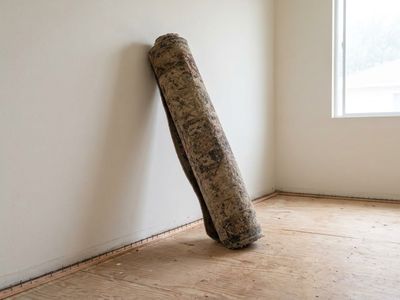
Whether it's still tacked down or already rolled up in the garage, we pull it up, cut it down and carry it out.
What we haul
- Wall-to-wall carpet, pulled up or already loose
- Carpet padding underneath
- Area rugs and runners, any size
- Carpet tile and commercial-grade carpet
- Carpet left behind in a move-out or rental turnover
- More than one room in the same visit
How it comes up and out
- Tell us how many rooms and whether it's still down.
- We pull it up where it's still attached, tack strips and all.
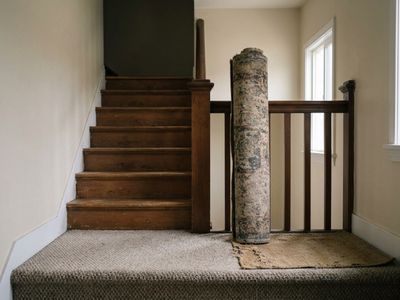
- It gets rolled or cut into sections, whatever the doorways and stairs call for.
- Padding comes up the same way, separately from the carpet itself.
- It goes out room by room and we sweep the floor behind it.
Before we arrive
- Clear furniture off any carpet that's still down.
- Tell us if any of it is wet. It changes how heavy the day gets.
What shape it's in when we get there
- Already rolled or cut. Loose and ready. A straightforward carry to the trailer.
- Still tacked or glued down. We pull it up first, then roll or cut it into sections.
- An area rug. Lighter and easier than wall-to-wall. No pulling up required.
- Wet or water damaged. A carpet that's around thirty pounds a square yard dry can triple in weight when it's soaked, and wool holds even more water than a synthetic fiber does.
Getting it down the stairs
Cut into sections, not carried in one piece
A synthetic carpet like nylon or polyester runs somewhere around five to eight pounds a square yard, and wool runs twelve to twenty. Add padding, which brings another half pound to a pound per square foot on its own, and a single room adds up fast.
A whole house is heavy, which is why it comes out cut into carry-able sections instead of dragged as one continuous roll down a hallway and a flight of stairs.
Water changes the math completely. A carpet that's roughly thirty pounds a square yard dry can weigh two to three times that once it's soaked, and we plan the day differently the moment you tell us a room flooded.
The CARE program
California has a carpet recycling program
California passed the first carpet-specific recycling law in the country back in 2010, funded by an assessment added when carpet is sold, not when it's thrown away. It's run by a nonprofit called CARE under state oversight, and it's unusual infrastructure for a single flooring material.
What that buys is narrower than it sounds. It funds collection and processing capacity for carpet as a material. It isn't something a hauling company enrolls in load by load, and a mixed trailer doesn't route into it that way.
So we won't tell you your carpet goes into that program specifically. What we'll tell you is that a clean carpet load is exactly the kind of material that program exists for, and it has a real place to go instead of a landfill.
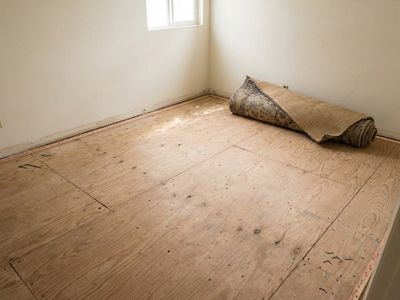
What's left once the carpet is up, tack strips, staples, glue residue, is yours to deal with before new flooring goes down. We clear the carpet and sweep up what came loose with it.
Who shows up
Crew and equipment
Every job runs out of an 8 × 12 ft dump trailer with 4 ft sides, about 14 cubic yards of space. Most jobs get a two-person crew, and we do all the lifting, loading and sweeping up.
Other ways to deal with old carpet
- The flooring installer. Many installers pull and haul the old carpet as part of a new floor going in, but only if you're using that installer, and some only pull it, leaving a rolled pile that still needs to leave the property.
- City bulky pickup. Downey and Los Angeles both list carpet as an accepted bulky item, and most nearby cities do the same, but you still have to get it pulled up, rolled and to the curb yourself, and a multi-room job can outlast one scheduled pickup.
- A rented dumpster. Works for a full room or a whole house, but means doing all the pulling and loading yourself, and a dumpster sitting on the driveway for days is its own commitment.
- A transfer station drop-off. Possible once it's already pulled up, rolled and loaded into a vehicle that can carry a few hundred pounds of dense, awkward material.
Flooring going in on a deadline?
Carpet & Rug Removal questions
Do you pull up carpet that's still glued or tacked down?
Yes. We pull it up, cut it into sections and carry it out, whether it's already loose or still attached to the floor.
Do you take the padding too?
Yes. It comes up separately from the carpet and goes out the same trip.
Can you get carpet down from an upstairs unit?
Yes. We've carried carpet down from a third floor. Stairs change how it's cut into sections, not whether we can do it.
Is wet carpet handled differently?
It's heavier, sometimes two or three times heavier than the same carpet dry, so we plan the day around that once you tell us.
Can you take just an area rug?
Yes. A rug is lighter and easier than wall-to-wall, and it doesn't need to be a whole-room job.
What's left on the floor after the carpet comes up?
Tack strips, staples or glue residue, depending on how it was installed. That part's on you before new flooring goes down. We clear the carpet and sweep up anything loose.
Locations served
Find us in your community
- Downey
- Whittier
- Paramount
- Long Beach
- Norwalk
- Bellflower
- Santa Fe Springs
- Anaheim
- Compton
- Lynwood
- Glendale
- Lakewood
- Pasadena
- Torrance
- Fullerton
- Los Angeles
- Pico Rivera
- Garden Grove
- South Gate
- Bell Gardens