
Washer and Dryer Removal
Washers and dryers hauled out of laundry closets, garages and rental units, stacked or side by side. Disconnect the water and the gas line to the dryer before we arrive, and we take it from there: onto a dolly, out the door, down the stairs if that's the way. Front-load, top-load, working or not. Serving Downey, Lakewood, Whittier, Long Beach and nearby cities, 7 days a week. Call or text and we'll work out a time.
Two different calendars, one call
Most calls start one of two ways. A new set is being delivered this week and the old one has to be out before the truck shows up. Or the washer already quit, leaking or refusing to spin, and a laundry room that doesn't work is today's problem.
A third pattern is just as common and easier to miss. A landlord or property manager is swapping an in-unit set between tenants. Laundry appliances turn over on the lease, not on a schedule anybody plans around, so these calls come in bunches around move-out season.
Whichever one it is, the job looks the same from here. Get the water and gas disconnected, and we handle the rest.
What we take
- Top-load and front-load washers
- Electric and gas dryers
- Stacked laundry units, unbolted and separated
- Sets from garages, closets and upstairs laundry rooms
- Working machines and broken ones alike
- Just the washer or just the dryer, if that's all that's going
- Rental and apartment laundry-room sets
How a laundry pickup goes
- Say whether it's stacked, side by side, or built into a closet, so we bring the right dolly.
- A stacking kit gets unbolted and the two machines separated before either one moves.
- Each one goes onto a dolly and out, down the stairs if that's the route.
- A front-loader's counterweight block adds real weight on the way out, and we plan the carry around it.
- From there it goes to be recycled, not landfilled.
Before we arrive
- Disconnect the water lines. If it's a gas dryer, have that line disconnected too.
- Drain any water left in the washer. A cycle stopped partway through can leave several gallons in the drum.
- Clear the path from the closet or laundry room to the door.
Which setup you have
- Top-load washer. The lighter of the two washer styles, and usually the simplest one through a doorway.
- Front-load washer. Often heavier than a top-load model of the same size. Many have a concrete block bolted inside the frame to keep the drum from walking during a fast spin.
- Gas dryer. Needs its own gas line disconnected, separate from the washer's water lines.
- Stacked unit. A dryer set on top of a washer with a stacking kit holding them together. That kit comes apart before either machine moves.
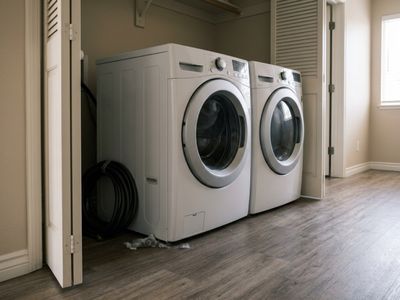
- Laundry closet set. Built into a bifold-door closet sized close to the machines themselves, common in apartments and condos.
Getting it out of the closet
The laundry closet is its own kind of tight
A laundry closet is often built to the machines' exact footprint, with only a few inches of clearance on the sides. A bifold or pocket door usually stands where a full swinging door would in a hallway, and that door is narrower to begin with.
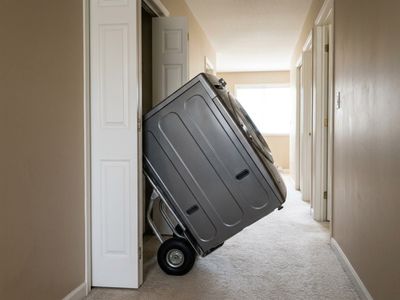
The straight width is rarely the actual limit. It's the turn out of the closet mouth into the hallway, in a space too tight for a washer to pivot the way a dresser would. We work out the angle before we lift, not after.
A stacked unit adds a step before any of that. Two machines instead of one, and neither moves until the stacking kit is off.
Before it leaves the property
What the law covers
A front-load washer shares one thing with an old refrigerator: a door that can latch shut around a space big enough for a child to climb into. California law groups them for that reason. Penal Code 402b covers washers and dryers alongside refrigerators and freezers, and leaving one at the curb where a child could get trapped is a misdemeanor.
That's the law about abandoning one, not a rule about how a pickup works. It's the actual reason the statute names washers and dryers at all, worth knowing if a curb drop-off is on the table instead.
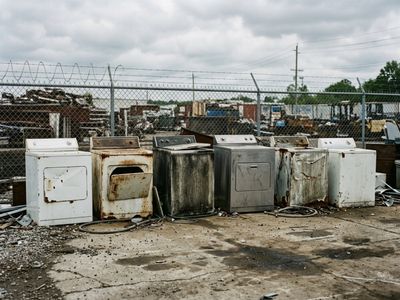
A washer or dryer is mostly steel, and steel has an obvious place to go. Ours are recycled instead of taking up space in a landfill.
Who shows up
Crew and equipment
Every job runs out of an 8 × 12 ft dump trailer with 4 ft sides, about 14 cubic yards of space. Most jobs get a two-person crew, and we do all the lifting, loading and sweeping up.
Other ways an old set can leave
- City bulky pickup. Downey and nearby cities collect appliances on a scheduled bulky pickup, but you disconnect the water and gas, drain the washer, and get both units to the curb yourself.
- Retailer haul-away on delivery. Removes the exact unit being replaced when a new washer or dryer is delivered, and usually needs the utilities already disconnected first.
- Landlord or property manager turnover. Works at the building level when a set is replaced between tenants, but doesn't help a single tenant or owner who needs one gone outside that cycle.
- A scrapper. Washers and dryers are steel appliances scrappers want, but most expect you to bring it to them and won't disconnect anything or carry it out.
- Marketplace or OfferUp. Works for a unit that still runs. You still have to disconnect it, move it somewhere a stranger can get to, and be home for their pickup window.
New set on the way?
Washer & Dryer Removal questions
Do I need to disconnect the washer and dryer myself?
Yes. Water lines and any gas line to the dryer need to be disconnected before we arrive. Once they're free, all the carrying is ours.
Can you take a stacked washer and dryer unit?
Yes. We unbolt the stacking kit and separate the two machines before either one moves.
Can I have just the washer taken and keep the dryer?
Yes. One machine or the pair, whichever is going.
Can you get a set out of an upstairs apartment?
Yes. Each machine goes down on a dolly. Mention the stairs and whether it's in a closet when you book.
What if there's still water in the washer?
Drain it before we arrive if you can. Standing water adds weight and a spill risk once it's on the dolly.
Is a front-load washer really heavier than a top-load one?
Often, yes. Many have a concrete counterweight block bolted inside to stop the drum from walking during a fast spin.
Locations served
Find us in your community
- Downey
- Whittier
- Paramount
- Long Beach
- Norwalk
- Bellflower
- Santa Fe Springs
- Anaheim
- Compton
- Lynwood
- Glendale
- Lakewood
- Pasadena
- Torrance
- Fullerton
- Los Angeles
- Pico Rivera
- Garden Grove
- South Gate
- Bell Gardens