
Household Trash Removal
Extra household trash that's outgrown your bin: move-out debris, post-party bags, a cleanup pile that's just trash and not furniture. Bagged or loose, we load it into the trailer and haul it off the same visit, no sorting required first. Serving Downey, Paramount, Lynwood and nearby cities. Call or text and tell us roughly how much there is.
The bin was never built for this week
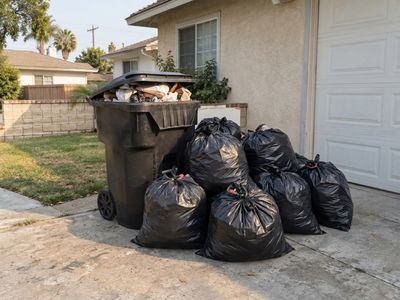
A trash bin is sized for a normal week, collected on a fixed schedule by a hauler working from a fixed-size cart. It isn't sized for a move-out, or the day after a party, or three closets finally getting cleared at once. When the pile is bigger than a normal week, the bin doesn't stretch to meet it. It just fills up.
That's really what this page is about. Not a type of object, the way almost every other page here is, just ordinary trash that needs to leave faster or in more volume than the bin and the schedule allow.
It's also the one job on the site people hesitate to call about, because it's just trash. It's still worth the call. A pile that's outgrown your bin is exactly what this is for.
What counts
- Bagged household trash, any amount
- Loose trash that never made it into a bag
- Packing debris and moving leftovers
- Post-party or event cleanup piles
- Trash left behind after a move-out
- Trash mixed in with anything else you're clearing
How it goes
- Tell us roughly how much there is, a few extra bags or a whole pile.
- We load it straight from where it's sitting, the curb, the garage or the yard.
- Bagged or loose, it goes into the trailer the same way.
- We sweep the spot before we go.
Before we arrive
- Bag it if you already have bags handy. If you don't, leave it loose. Either way works.
- Point us to everything you want gone, including anything mixed in that isn't technically trash.
Why this one is about space, not weight
The trailer fills by volume here, not by weight
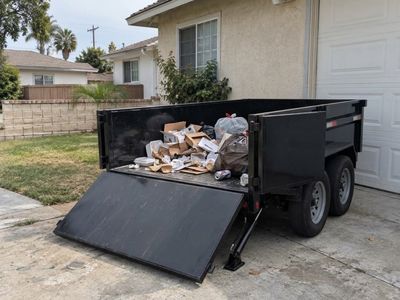
Most of what leaves in the trailer is dense: furniture, appliances, concrete. Household trash is the opposite. Bags of packaging and loose debris are light for their size, so a real pile of it can take up a serious share of the trailer's roughly 14 cubic yards without weighing much at all.
Loose material loads a little slower than bagged trash, because it needs careful handling to keep it from spilling on the way in. Bagged is faster, though a bag mixed with something sharp can tear, so we watch for that either way.
This is also the job that surprises people most. A move-out or a big cleanup can generate more volume than anyone expects, simply because trash doesn't compress the way flat furniture does.
Why the bin runs out first
Regular collection is built for a normal week
Franchise hauling contracts, the kind that give one company exclusive collection rights in a city, are built around a standard cart on a fixed schedule, not unlimited volume. That's a contract limit, not anything personal, and it's the actual reason overflow becomes a problem exactly the week you need extra capacity gone.
Los Angeles runs a real workaround for it: residents can buy tags ahead of time and stick them on bags left outside a full bin, and without one, those bags get left behind on collection day. Not every city here runs the same program, and even where it exists, it only covers ordinary trash on your regular pickup day, not a same-day pile.
Bulky-item pickup is a separate program entirely, built for large single items like a couch or a mattress on a scheduled date. It gets confused with overflow trash because the two sound alike. They're not the same problem, and one doesn't solve the other.
Who shows up
Crew and equipment
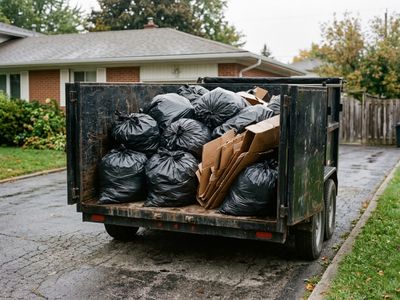
Every job runs out of an 8 × 12 ft dump trailer with 4 ft sides, about 14 cubic yards of space. Most jobs get a two-person crew, and we do all the lifting, loading and sweeping up.
Other ways to deal with overflow trash
- Wait for the next collection day. Free, and requires nothing from you, but it doesn't solve a volume problem. Extra bags left outside a full bin often just get skipped.
- Extra capacity tags, where your city offers them. Solves the loose-bags problem for ordinary trash on your regular day, but you have to know the program exists and buy tags before the pile shows up, not after.
- Bulky-item pickup. A different program built for large individual items on a scheduled date. It doesn't reach ordinary trash volume no matter how it's described.
- A rented dumpster. Handles real volume, but it's a multi-day commitment: delivery, driveway space, then a pickup to schedule, disproportionate for a one-time overflow.
- A transfer station run yourself. Needs a vehicle that can carry the volume and the time to load it and drive there.
More trash than the bin can hold?
Household Trash Removal questions
Does the trash need to be bagged first?
No. Bagged or loose, we take it as it sits. Bagged just loads a little faster.
Is this too small a job, it's just a few extra bags?
No. A handful of extra bags is a completely normal call, not just a big pile.
Can you come the same day after a move-out?
Usually, yes, same day most of the time, seven days a week.
What's the difference between this and bulky pickup?
Bulky pickup is for large single items on a scheduled date. This is for ordinary trash volume, any time, no scheduling ahead required.
Will you take trash that's mixed in with furniture or other stuff?
Yes. It doesn't need to be sorted out first.
Can a landlord get move-out trash cleared before a new tenant arrives?
Yes. That timing is a normal reason people call.
Locations served
Find us in your community
- Downey
- Whittier
- Paramount
- Long Beach
- Norwalk
- Bellflower
- Santa Fe Springs
- Anaheim
- Compton
- Lynwood
- Glendale
- Lakewood
- Pasadena
- Torrance
- Fullerton
- Los Angeles
- Pico Rivera
- Garden Grove
- South Gate
- Bell Gardens